
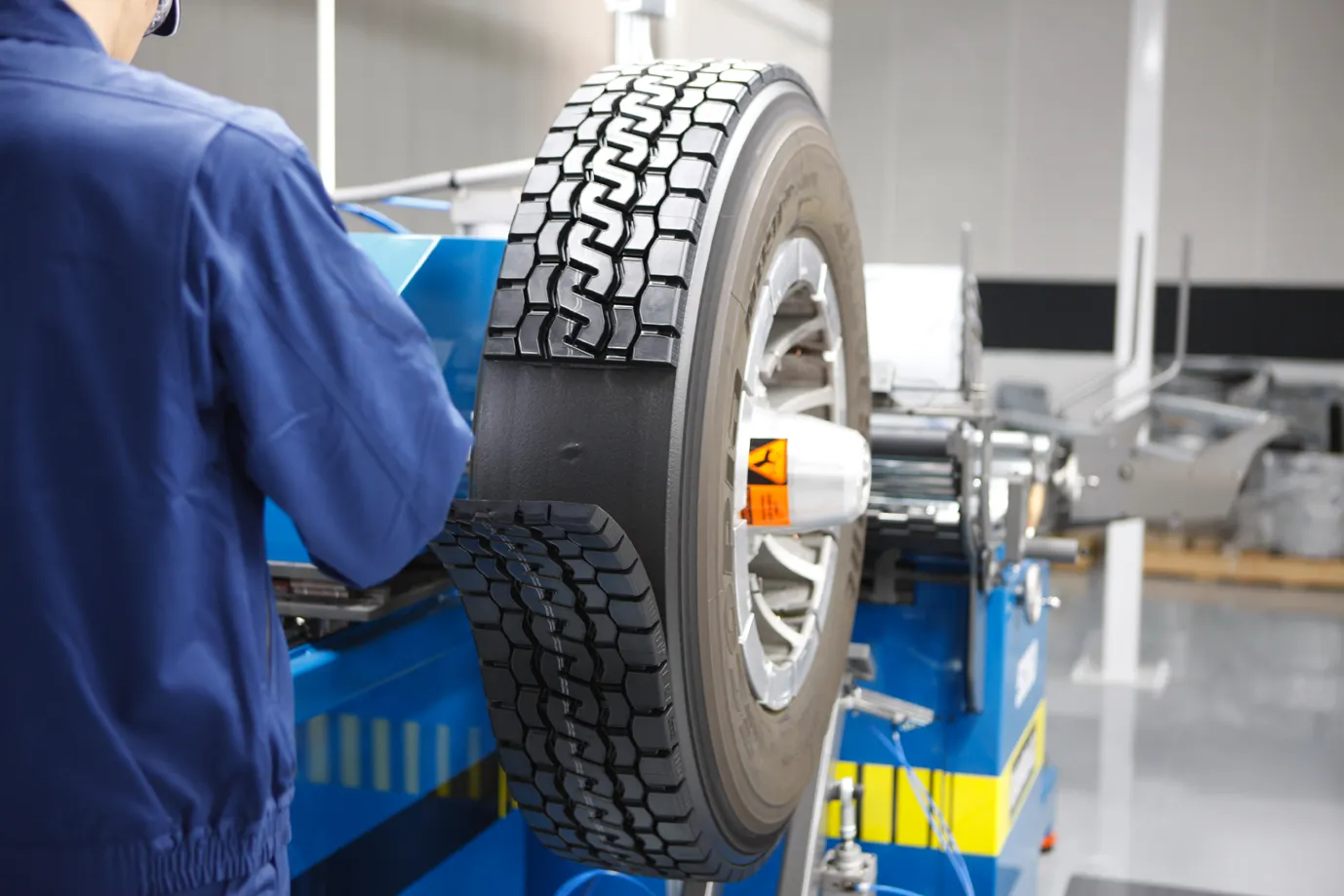
Japan’s tyre retreading business is well developed compared with other Asian nations. Currently, Japan’s retreading market is experiencing growth and expansion. Due to current social and economic conditions, transportation companies are facing increasing cost pressures, which is creating favourable conditions for the retreading market, as retreaded tyres help reduce tyre-related expenses.
Growth Reported in Japanese Retread Sector
While the exact total number of Japanese retreaders is not readily available, a total of 8 companies registered as full members with the National Retread Tyre Council (an industry association), such as Bridgestone BRM Co., Ltd, Dunlop Retread Service Co., Ltd, Yokohama Tyre Retread Co., Ltd, and Toyo Retread Co., Ltd. These major tyre manufacturers currently lead the domestic retread market. The council has also 5 Associate member companies.
The retreading methods employed in the Japanese retread tyre market reflect operational preferences shaped by considerations regarding precision requirements, service predictability, and performance reliability. Precure retreading remains widely used because the separation of tread manufacturing and casing bonding maintains controlled workflow management and consistent processing conditions. Retreading companies often find this method suitable for maintaining production stability while meeting deadlines required by organized fleets.
Bridgestone BRM has 13 retread factories in Japan, all of which are self-owned. About half of them use only the precure process, while the others are mould cure, and so both manufacturing processes are supported. The company respond to market demands by efficiently combining mould cure and precure manufacturing methods.
For the Bandag mould cure brand, they primarily select tread patterns that are suitable for the Japanese market, focusing on applications for special vehicles and rare sizes. These products are then introduced and marketed accordingly in Japan.
Bridgestone BRM told Retreading Business: We are currently transforming our business to create value across the entyre lifecycle—spanning production, usage, reuse, and resource circulation. Within this framework, retreading is positioned as a key initiative linking the usage and resource circulation stages. Also, we are actively promoting it as a means to contribute to the realisation of a circular economy and carbon neutrality by extending tyre lifespans and ensuring the effective use of resources.
When asked about fleets’ view on retreading, Bridgestone BRM replied: We believe that the solution is being adopted across the board, regardless of the size of the user’s fleet. Large fleet operators, in particular, face a need to not only cut costs but also respond to shippers’ demands for environmental initiatives—a need driven by recent social trends. Retread tyres are an excellent fit for addressing these challenges.
Bridgestone’s truck and bus tyre business (including the retreading business) accounted for approximately 23% of its consolidated sales revenue in 2025. Bridgestone is also promoting retreading as a core component of its circular business model. The company aims to increase the truck and bus tyre retreading ratio (for commercial use) to approximately 50% by 2026, and it was 47% in 2025.
Michelin Japan
Currently in Japan, many tyres are discarded with approximately 50% of their lifespan remaining. As one of its key initiatives, Michelin Japan is promoting the regrooving and retreading of its truck and bus tyres. These tyres are designed from the outset with regrooving and retreading.
In February, Michelin Japan announced that it will promote the extension of the lifespan of its “Solideal” solid tyres for forklifts through regrooving. Regroove is falls under Michelin’s five priorities for reducing environmental impact. The recommended groove depth per pass is a maximum of 15 mm. If there is rubber remaining above 60J (SAFETY LINE), multiple regrouting is possible.
Michelin Japan proposes tread repair for forklift tyres at 60 locations by the end of the year. In the future, Michelin employees will conduct regrooving training and demonstrations upon request, and a system will be established where trained workers can perform the procedure themselves.
Hiroaki Matsuoka, Representative Director, Fuji Holdings Co., Ltd. and Fuji Transport Co., Ltd. Said: Michelin is truly dedicated; they even come to our company to measure the remaining tread depth on our tyres. No other domestic tyre manufacturer did this much, and we had a lot of blowouts, so now, although they’re a bit expensive, we use 100% Michelin tyres.
“Also, with Michelin, not only do we buy tyres, but a representative comes to our company and measures the remaining tread depth free of charge. We’ve found that the tyres have a long lifespan, and there’s no uneven wear, so drivers can drive with peace of mind. Our company owns over 50,000 tyres, so managing them is quite a task”, Matsuoka added.
Sumitomo Rubber Industries
In August, Sumitomo Rubber released the “SP011”, a studless tyre for trucks and buses that promotes retreading. The “SP011” improves the quality of the tyre as a base tyre for retreading by revising the case profile and bead structure.
The new profile optimises the rubber thickness of the sidewall to improve rim mounting workability, and the new bead structure strengthens areas prone to damage during rim mounting, suppressing bead peeling. Furthermore, the “SP011” is the first Dunlop truck and bus tyre to adopt a “retread guide sign” that is exposed as it wears down.
Toyo Retread
Currently, Toyo Retread operates from two locations, the Itoigawa Plant in Niigata Prefecture and the Otaru Plant in Hokkaido, shipping approximately 500 retreaded tyres per day, or about 130,000 per year, nationwide. Toyo Retread established a detailed inspection system from the selection of base tyres to pre-shipment inspections, including inspections of damage using high voltage, inspections of the inside of the tyre that cannot be detected from the outside, and durability checks of the finished product, and produced 123,200 retread tyres in 2025.
The company explains that retreaded tyres can be sold at a lower price than new tyres, and that they reduce resource consumption by approximately 68% and CO2 emissions by approximately 64% during manufacturing.
Calculated Benefits of Tyre Retreading in Japan
Japan Automobile Tyre Manufacturers Association (JATMA) surveyed the sales of new and retread tyres in 2024 and summarised the resource savings and CO2 emission reductions based on the research results. For this estimation, the data on the retreaded tyres in the Japanese market for each fiscal year was provided by Japan Retreaders’ Association.
Although the retreading rates remained at approximately 18% from 2018 to 2022, the rate reached 20% in 2023. 2024’s rate was at the same level as 2023’s, at 19.9%.
Retreading rates in the Japanese market
| 2018 | 2019 | 2020 | 2021 | 2022 | 2023 | 2024 | ||
| The number of tyres sold in Japan (Ten thousand pieces) |
Total | 671.4 | 665.9 | 599.4 | 648.0 | 679.4 | 637.9 | 630.9 |
| New | 550.6 | 545.8 | 489.4 | 532.2 | 556.9 | 510.6 | 505.6 | |
| Retread | 120.8 | 120.1 | 110.1 | 115.8 | 122.5 | 127.3 | 125.3 | |
| Retreading rate (%) | 18.0 | 18.0 | 18.4 | 17.9 | 18.0 | 20.0 | 19.9 | |
Resources saved through the spread of retread tyres
In retread tyre production, since the tyre casing is reused, the only new input material is tread rubber. Comparing it to new tyre production, the resource usage can be reduced by approximately 69% and the CO2 emissions can be reduced by approximately 65% (calculated for the representative size of 275/80R22.5 in the Tyre LCCO2 Calculation Guidelines).
The below line chart shows the calculated resources saved from 2018 to 2024 in the entire Japanese market. These reductions were calculated by comparing to a case where all tyres sold were assumed to be new tyres, and they are proportional to the number of retread tyres sold.
Resources saved in the Japanese market
The resources saved in 2020 and 2021 were lower due to the strong impact of the spread of COVID-19; the amount recovered after that and, since 2022, the amount of resources saved has surpassed the level before the spread of COVID-19, remaining steady. The resources saved in 2024 were approximately 48,000 tons per year. This is equivalent to approximately 870,000 tyres when converted using an average weight of new tyres in the size of 275/80R22.5.
CO2 emissions reduced through spread of retread tyres
The below table lists the CO2 emissions reduced at each stage of the life cycle in the Japanese market from 2018 to 2024 compared to a case where all the sold tyres were assumed to be new tyres. The amount of the CO2 emissions reduced in 2024 was 217,000 tons. This amount was slightly lower than 2023, partly because the total number of tyres sold in Japan in 2024 slightly decreased. This is equivalent to the CO2 emissions released when approximately 1,190,000 new tyres in the size of 275/80R22.5 are produced.
CO2 emissions reduced in the Japanese market
| Reduced CO2 emissions (ten thousand tons) | 2018 | 2019 | 2020 | 2021 | 2022 | 2023 | 2024 |
| Raw material production stage | 11.5 | 11.4 | 10.5 | 11.0 | 11.6 | 12.1 | 11.9 |
| Raw material transportation stage | 0.8 | 0.8 | 0.7 | 0.7 | 0.8 | 0.8 | 0.8 |
| Tyre production stage | 2.0 | 2.0 | 1.8 | 1.9 | 2.0 | 2.1 | 2.0 |
| End of life and recycling stage | 6.7 | 6.7 | 6.1 | 6.5 | 6.8 | 7.1 | 7.0 |
| Total | 20.9 | 20.8 | 19.1 | 20.1 | 21.2 | 22.1 | 21.7 |
CO2 emissions reduction effects in each stage were calculated as follows.
Raw material production stage: Calculated the difference of the CO2 emissions released in the production of raw materials for new tyres and for retread tyres.
Raw material transportation stage: Calculated the difference of the CO2 emissions released in the transportation of raw materials for new tyres and for retread tyres.
Tyre production stage: Calculated the difference of the CO2 emissions released in the production processes for new tyres and for retread tyres.
End of Life and recycling stage: Based on a scenario where the export of used tyres to overseas would decrease due to reuse of end-of-life tyres (tyre casing) as retread tyres in Japan, the CO2 emissions in the end of life and recycling stage were calculated.
In conclusion, the current retreading rate in Japan is lower than those in Western countries. Increasing the retreading rate would further contribute to realising a sustainable society in Japan.
Author: Mainbayar Badarch
Image: Bridgestone