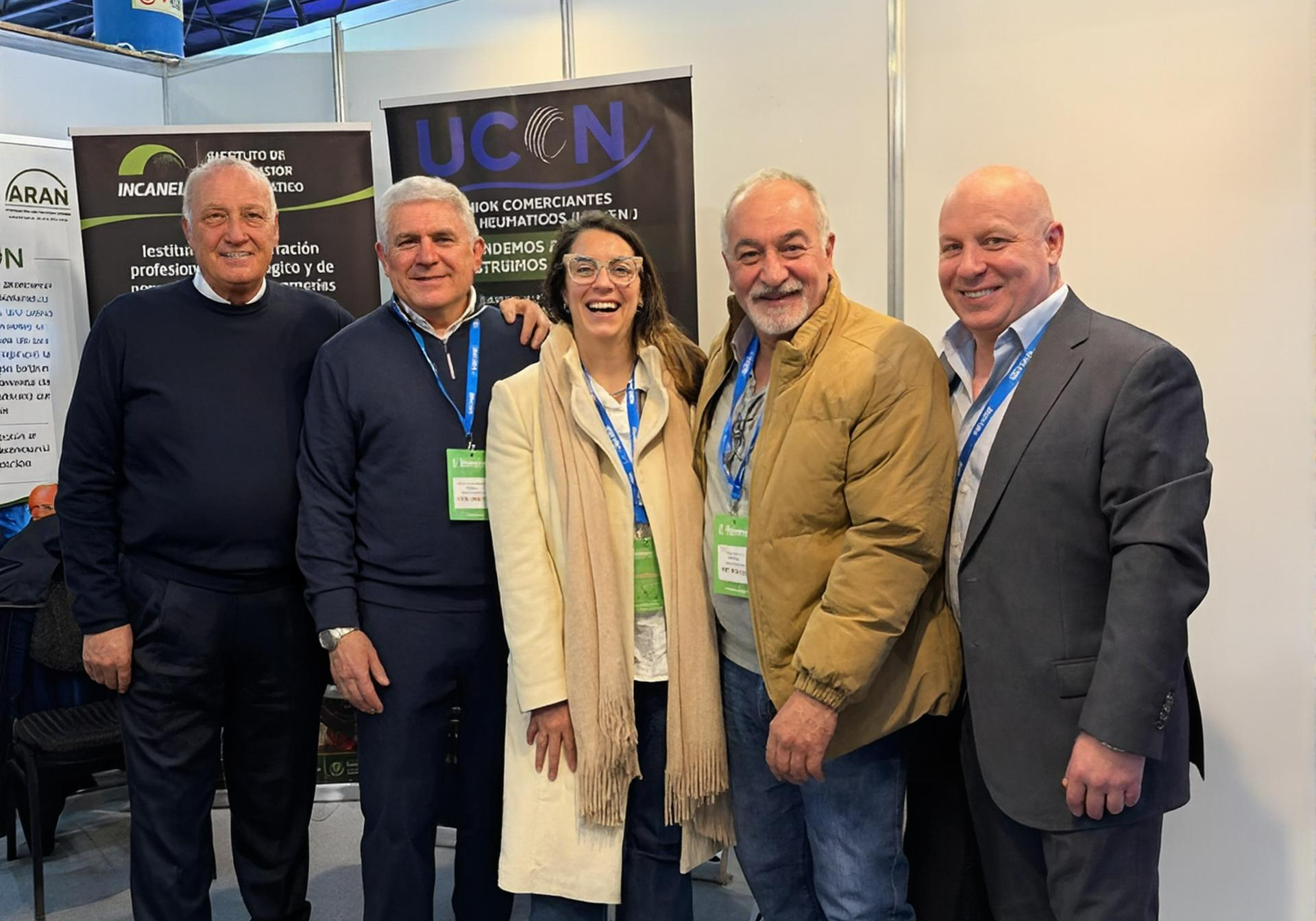
Expo Transporte 2026 offered more than a showcase of Argentina’s transport sector. For Diego Gastón Pastor, General Manager of ARAN, the Asociación de Reconstructores Argentinos de Neumáticos, it also provided a revealing snapshot of a market undergoing structural change. Chinese tyre brands are increasingly part of the competitive landscape; traditional industry players have a noticeably reduced presence, and Argentina’s retreading sector faces a fundamental choice: wait for conditions to change or adapt to a new reality.
Retreading in Argentina Highlighted at Expo Transporte
Held from 11–13 August at La Rural exhibition centre in Buenos Aires, the 14th edition of Expo Transporte took place alongside the 16th Expo Logisti-k. Together, the exhibitions brought more than 450 companies into approximately 28,000 square metres of exhibition space, covering freight and passenger transport, commercial vehicles, logistics, equipment, tyres and fleet-related services.
For ARAN, the event provided an opportunity not only to observe the state of Argentina’s transport market but also to meet other industry organisations and assess the position of retreading within a rapidly changing competitive environment. Pastor came away from the exhibition with mixed feelings — but little surprise.
China Is No Longer A Temporary Issue
One of the clearest impressions from Expo Transporte was the continuing expansion of Chinese brands across the transport and tyre sectors.
For Pastor, this is significant not simply because Chinese tyres compete with domestically manufactured or traditionally established brands, but because the industry needs to reconsider the way it understands that competition.
“My impression of Expo Transporte 2026 generates mixed feelings, but, in truth, it does not surprise me at all,” Pastor told Retreading Business. “What we saw clearly represented was a trend that we have already been observing in our sector: the presence of Chinese tyre brands and related services.”
Pastor deliberately describes this as a new “reality”, rather than simply a problem confronting the industry.
“We cannot continue thinking about, analysing and living with imported products from China as a ‘problem’,” he explained. “If we continue looking at it that way, we will continue waiting for solutions to that problem that may never arrive.” That change in perspective has important implications.
If low-cost imported tyres are treated primarily as a temporary distortion, companies may be tempted to wait for a political or regulatory response, a new government, different import policies or measures designed to protect domestic industry. Pastor believes this approach carries its own risk.
The international tyre market has already changed. Global production, trade flows and the growing presence of Asian manufacturers have created competitive conditions that local companies cannot control. The challenge for Argentine companies is therefore increasingly about determining how they compete within those conditions.
“The new global reality brings with it new paradigms,” Pastor said. “Of course, they do not have the same effects everywhere, precisely because of the variety of scenarios and the different situations of local companies.”
This point is particularly relevant in Argentina, where much of the retreading industry consists of SMEs. These businesses operate with very different resources and economies of scale from the large international manufacturers whose products increasingly influence the market.
A Noticeable Absence From Expo Transporte
The composition of Expo Transporte itself reinforced Pastor’s perception that the market is changing.
Despite the scale of the exhibition, the factories, local subsidiaries and importers representing Argentina’s principal historic tyre brands were notably absent. This was particularly striking, given that Argentina continues to have domestic tyre manufacturing, including operations by Bridgestone and Pirelli.
The contrast was even more evident from the perspective of retreading. “There was an almost complete absence of manufacturers and suppliers of materials and inputs for tyre retreading, unlike what we had seen on previous occasions,” Pastor said.
That does not mean that the transport sector itself lacked representation.
Traditional heavy commercial vehicle brands maintained a significant presence, together with passenger transport vehicles, bodybuilders, manufacturers of truck-mounted cranes and companies providing technology and services to fleets. In other words, transport remained visible — but tyres, and particularly retreading, occupied a considerably smaller space than they had at previous editions.
For an industry association such as ARAN, that absence is worth considering. Exhibitions are not simply commercial showcases; they also indicate where industries are investing, communicating, and positioning themselves in front of fleet operators.
If retreading becomes less visible in those environments, the sector faces an additional challenge: ensuring that its economic, technical, and environmental contributions remain part of the transport industry conversation.
Retreading Depends On Transport and Transport On The Economy
Expo Transporte nevertheless provided ARAN with an important opportunity away from the exhibition stands.
Pastor and the association held meetings with organisations representing sectors closely connected with road transport in Argentina. These conversations created an opportunity to reactivate relationships that had weakened over time and explore new areas of institutional cooperation.
“We found an opportunity to revive old alliances and resume dialogue in order to strengthen strategies,” Pastor explained.
The reasoning is straightforward.
Retreading cannot be analysed separately from transport activity. Commercial tyres generate value by travelling kilometres, and when freight movements, passenger transport or economic activity slow, the effects eventually reach tyre dealers, service providers and retreaders.
“It is imperative that transport recovers its activity, with everything that entails,” Pastor said. “And, conversely, this also depends on what is required from the rest of the economy for transport to return to adequate levels of activity.”
For ARAN, this interconnectedness creates a strong argument for working more closely with transport associations and other industrial organisations.
The future of retreading is not determined exclusively inside retreading plants. It is also influenced by freight volumes, fleet economics, tyre purchasing decisions, public policy and the wider competitiveness of domestic industry.
Building alliances, therefore, becomes part of the sector’s response.
From Defending The Industry To Reinventing It
Perhaps the most significant conclusion from Pastor’s assessment is that adaptation cannot depend exclusively on external intervention.
Argentina’s retreaders have little control over international manufacturing capacity, global tyre prices or the strategies of foreign producers. They also cannot base their long-term plans on the expectation that political conditions will eventually restore the market to an earlier structure.
Instead, Pastor argues that the industry needs to concentrate on the areas where it can act.
“We have to reinvent ourselves, continue innovating, develop new strategies and look for other opportunities,” he said. “It is not easy at all, but we cannot remain stagnant waiting for solutions to fall from the sky.” For retreaders, this means competing on more than the initial purchase price of a tyre.
Retreading has traditionally built its value proposition around extending casing life and reducing fleet tyre costs. In a market increasingly populated by inexpensive new tyres, communicating that lifecycle value becomes even more important.
It also means ensuring that retreading remains visible within discussions about transport efficiency, industrial competitiveness and resource use.
This is where industry associations play an increasingly important role. ARAN’s meetings during Expo Transporte suggest that the response may require broader coalitions rather than isolated action by individual retreaders.
From that perspective, the relatively limited presence of the traditional tyre and retreading industries at Expo Transporte does not necessarily render the exhibition irrelevant. It may instead make the message emerging from Buenos Aires more important.
Argentina’s retreading industry operates in a market unlikely to return to past conditions. Chinese tyre brands, changing trade patterns, pressure on domestic SMEs and an uncertain economic environment are no longer exceptional events. They are increasingly part of the conditions under which companies must operate.
The strategic question is therefore changing.
It is no longer simply about how the industry can protect itself from the new competitive environment, but how it can remain relevant and profitable within it.
For Pastor, that means innovation, cooperation and a willingness to reconsider established strategies.
Expo Transporte 2026 may therefore be remembered by Argentina’s retreading industry less for what was exhibited than for what the exhibition revealed: waiting for the old market to return is not a strategy. Adapting to the new one is.